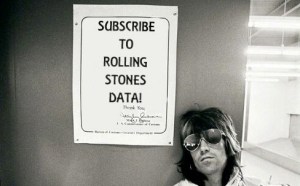
Like what you see? Help keep it going! This site runs on the support of readers like you. Your donation helps cover costs and keeps fresh Rolling Stones content coming your way every day. Thank you!
TheRolling Stones in the press: “Stones Roll the Dice”
In April ’72, anticipation around the Rolling Stones reached a familiar boiling point. A year after Brown Sugar, expectations were sky-high, and Tumbling Dice arrived with a confidence that didn’t need to shout. At first it rolls in casually, almost loose, but give it a moment and the groove locks tight, radiating that unmistakable Stones swagger. The song feels lived-in rather than polished, driven by feel instead of flash. It’s Exile on Main St. distilled: ragged rhythms, irresistible momentum, and Mick Jagger sounding completely at home inside the chaos. Not a track that grabs you by force, Tumbling Dicewins by seduction—proof that the Stones knew exactly when to lean back and let rock ’n’ roll do the work.
“Tumbling Dice” (Rolling Stones). It’s been a year since the Stones released the “Brown Sugar” maxi-single. A long time. Too long in fact. Anyway, “Tumbling Dice” is a Jagger/Richard composition from their forthcoming double album “Exile On Main Street.” It’s not a song that immediately hits you, but soon enough the Stones’ magic shines through as bright as ever.
This mid-tempo number sounds typically Stones. Jim Price and Bobby Keys are absent, but in their place is a nice female back-up vocal team. The guitars use a ringing chord technique, and Charlie Watts manages to fit in a few trim drum fills while Wyman’s bass plods its usual course.
On the flip side, “Sweet Black Angel” incorporates acoustic guitars, percussion and harmonica. Mick and Keith sing and wrote it. Produced by Jimmy Miller and mixed by Andrew Johns, the single is in stereo as well.
More about The Rolling Stones’ Tumbling Dice
*By Marcelo Sonaglioni Tumbling Dice originally began as a song written by Mick Jagger, under the title Good Time Women. The initial lyrics explored the transactional relationship between a woman working in the red-light district and her client. At one point, the woman tells him, “Yes you got me silly/ And you know you gonna die with your wife/ Baby, baby/ Red light woman…” echoing themes similar to those found in the Honky Tonk Women lyrics—a story of love, loss, and the complex nature of relationships.
Keith Richards then took the basic structure of this early version and reworked it, bringing his own musical influence into the song. Mick Jagger, in turn, crafted new lyrics, refining the song into what would become Tumbling Dice. Keith Richards has remarked that the song might have been inspired by the atmosphere at Nellcôte, the French villa where the band was staying while recording Exile on Main St. At the time, the house had turned into a kind of gambling den, with card games and roulette wheels set up throughout. Richards notes that Monte Carlo, a famed gambling hub, was just around the corner, which could have influenced the song’s themes of luck, chance, and risk.
By combining elements of their experiences in the lively and chaotic environment of Nellcôte with the earlier concept of the woman’s story, the Stones transformed Good Time Women into the rock classic we know today. Tumbling Dicebecame one of their most iconic tracks, blending gritty realism with the band’s signature swagger and musical depth. Stones roll the dice? Oh sure they do…
Like what you see? Help keep it going! This site runs on the support of readers like you. Your donation helps cover costs and keeps fresh Rolling Stones content coming your way every day. Thank you!
Privacy & Cookies: This site uses cookies. By continuing to use this website, you agree to their use.
To find out more, including how to control cookies, see here:
Cookie Policy
Subscribe to the Stones Data newsletter and get all daily posts delivered to you for free. Everybody got to go! *Support this site and help us keep sharing great content. Thanks in advance!