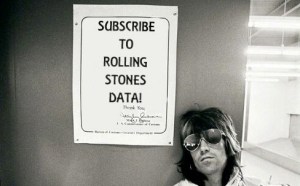
Like what you see? Help keep it going! This site runs on the support of readers like you. Your donation helps cover costs and keeps fresh Rolling Stones content coming your way every day. Thank you!
Rolling Stones songs: Under the Radar
You changed your number/ To try to bait me/ I phoned your mother… yes/ She tried to date me…
Under the Radar isn’t simply about a troubled relationship or a warning ignored. It reflects a broader late-career instinct within the Rolling Stones: the desire to remain dangerous without being obvious. By the mid-2000s, dominance was no longer the point. Visibility had become a liability. This song operates in that space, where control is exercised quietly and power comes from restraint rather than force.
What makes the track revealing isn’t its plot, but its posture. It favors observation over declaration, ambiguity over resolution. The narrator wants influence without exposure, authority without spectacle — a position that mirrors the Stones themselves at this stage of their career. The song doesn’t try to update their sound or compete with the present moment. Instead, it circles familiar emotional ground with deliberate caution, as if understanding that longevity depends not on volume, but on discretion.
Seen this way, Under the Radar isn’t a leftover or an anomaly. It’s a document of a band learning how to survive its own history by stepping slightly out of view.
More about Under the Radar by The Rolling Stones
*By Marcelo Sonaglioni
The art of slipping past the spotlight
Sometimes the most revealing Rolling Stones tracks are the ones that never quite step into the spotlight. Under the Radar lives in that shadowy space, a song that feels deliberately evasive, as if it prefers to watch the world rather than announce itself. The phrase itself suggests invisibility, but also a quiet resistance to the obvious and the fashionable, aligning more with counterculture instincts than mainstream gestures. At its core, the song presents a narrator caught in emotional contradiction: protective yet frustrated, confident yet unsettled. He positions himself as a warning voice, someone who sees danger where the object of his affection refuses to look.
Her other partner appears polished on the surface—wealthy, smooth, socially acceptable—but beneath that sheen lies cruelty and manipulation. This tension fuels the song’s unease, turning it into less a love story than a study in obsession, control, and the limits of loyalty, all delivered with the Stones’ trademark ambiguity.
Meaning beneath the surface
Rather than offering a straightforward moral stance, Under the Radar thrives on uncertainty. Mick Jagger’s lyrics (“You say you want me / And then you taunt me / Try to reform me / You drive me crazy”) The song’s narrator strives to be a protector for the woman he loves, yet he finds himself conflicted by her unpredictable and inconsistent behavior towards him.sketch a narrator who wants to be a savior, yet cannot escape the suspicion that his motives are tangled with ego and jealousy. His warnings sound sincere, but they are also tinged with desperation.
The woman’s behavior—alternately inviting and dismissive—keeps him off balance, reinforcing the sense that no one in this scenario holds the moral high ground. The song subtly critiques appearances: wealth and charm are presented as masks that can hide something corrosive, while concern and affection can slip into possessiveness. By avoiding clear resolutions, the track mirrors real emotional conflicts, where truth is fragmented and intentions are rarely pure. This lyrical restraint makes the song feel more observational than judgmental, inviting listeners to read between the lines rather than accept a single, comforting explanation.
Sound and performance
Musically, the track leans heavily on the Rolling Stones’ long-honed chemistry. From the opening moments, the guitars weave together with a familiarity that feels instinctive rather than rehearsed. Keith Richards and Mick Jagger share a riff-driven conversation that anchors the song, while Charlie Watts’ drumming sits in a fluid space between rock propulsion and jazz looseness. Jagger’s vocal delivery carries decades of blues phrasing and ironic bite, sounding conversational yet pointed, as if he’s letting the listener in on a private frustration. Ronnie Wood’s slide guitar adds texture rather than flash, supporting the mood before stepping forward briefly near the end. The overall feel deliberately echoes the band’s late-1960s sensibility, favoring atmosphere and groove over modern polish. It’s a sound that reinforces the song’s theme of existing slightly out of time and just outside the frame.
Echoes of the past
One reason Under the Radar resonates so strongly is its unmistakable heritage. The track feels genetically tied to the Rolling Stones’ late-1960s work, especially their darker, introspective moments. The circling guitar figure and understated melody echo a familiar Stones approach: tension held back rather than released, atmosphere favored over fireworks. Whether this sense of déjà vu is deliberate nostalgia or simply the band falling back on instincts shaped over decades is open to interpretation. Jagger’s laid-back drawl and Richards’ harmonies reinforce that backward glance, recalling a time when ambiguity and mood were central to the Stones’ identity. Still, the song never slips into self-imitation. Instead, it sounds like seasoned musicians revisiting old emotional ground with clarity and distance, conscious of their past without being confined by it.
From the opening bars, the band’s essence is unmistakable. The guitars interlock effortlessly, Charlie Watts anchors the groove with his jazz-inflected rock feel, and Jagger delivers his lines with that familiar, sly bite. The influence of Child of the Moon is clear, while Ronnie Wood’s slide guitar quietly weaves in before emerging late, mixed subtly rather than spotlighted.
Lost track, lasting impression
Recorded across sessions in mid-2004 and mid-2005, Under the Radar ultimately didn’t make the final cut for A Bigger Bang. Its exclusion remains puzzling, especially given its strong sense of identity and emotional coherence. The decision may have stemmed from its resemblance to earlier work or from production choices that left certain sections feeling unsettled. Still, imperfections can sometimes enhance a song’s character, and here they contribute to its restless mood. The track survived only as part of the A Bigger Bang Special Edition DVD, reinforcing its status as a hidden artifact rather than a headline statement. Ironically, that marginal position suits it perfectly. Free from the burden of representing an album or era, “Under the Radar” stands as a reminder that some of the Rolling Stones’ most compelling moments happen quietly, away from expectations, where nuance and tension have room to breathe.
Like what you see? Help keep it going! This site runs on the support of readers like you. Your donation helps cover costs and keeps fresh Rolling Stones content coming your way every day. Thank you!